FLOP weights
Weighted FLOP counting
The counted_float package contains a set of default, built-in FLOP weights,
based on both empirical measurements and theoretical estimates of the relative
cost of different floating point operations.
See Methodology for the rationale behind the choice of data sources and methodology, and CPU architecture scope for the CPUs covered.
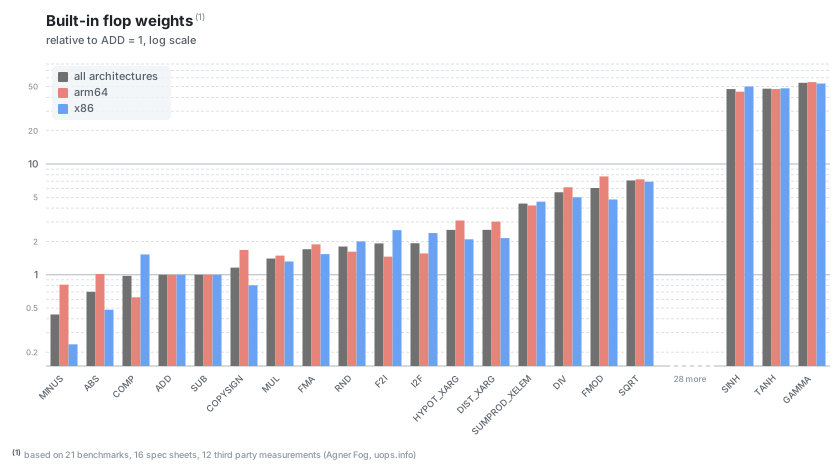
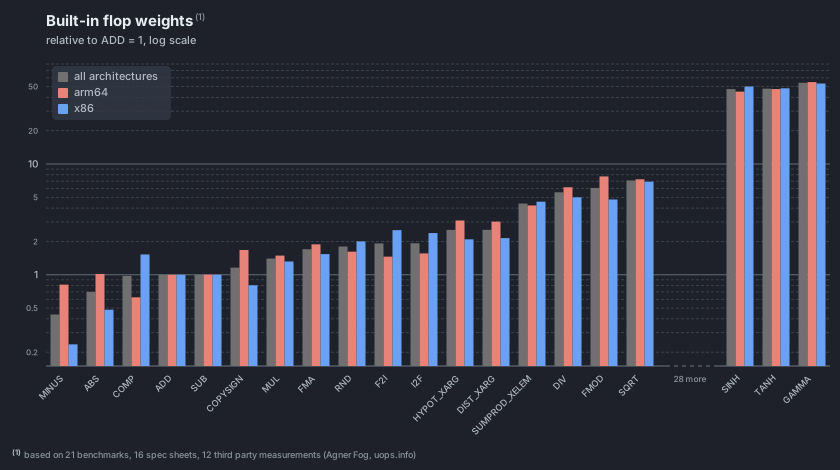
The cheapest and priciest operations, with the two architectures shown against the all-architecture consensus. Note the log scale: the range spans more than two decades, and the two ISAs disagree most at the cheap end.
>>> from counted_float.config import get_active_flop_weights

>>> get_active_flop_weights().show()

{
    FlopType.MINUS          [-x]              :   0.45000
    FlopType.ABS            [abs(x)]          :   0.70000
    FlopType.ADD            [x+y]             :   1.00000
    FlopType.COMP           [x<=y]            :   1.00000
    FlopType.SUB            [x-y]             :   1.00000
    FlopType.COPYSIGN       [copysign(x,y)]   :   1.20000
    FlopType.MUL            [x*y]             :   1.40000
    FlopType.FMA            [x*y+z]           :   1.80000
    FlopType.RND            [round]           :   1.80000
    FlopType.F2I            [float->int]      :   2.00000
    FlopType.I2F            [int->float]      :   2.00000
    FlopType.DIST_XARG      [dist(+arg)]      :   2.40000
    FlopType.HYPOT_XARG     [hypot(+arg)]     :   2.40000
    FlopType.SUMPROD_XELEM  [sumprod(+elem)]  :   4.50000
    FlopType.DIV            [x/y]             :   5.50000
    FlopType.FMOD           [fmod(x,y)]       :   6.00000
    FlopType.SQRT           [sqrt(x)]         :   7.00000
    FlopType.REMAINDER      [remainder(x,y)]  :  11.00000
    FlopType.EXP2           [2^x]             :  14.00000
    FlopType.EXP            [e^x]             :  16.00000
    FlopType.HYPOT          [hypot(x,y)]      :  18.00000
    FlopType.LOG            [log(x)]          :  18.00000
    FlopType.SUMPROD        [sumprod(p,q)]    :  20.00000
    FlopType.DIST           [dist(p,q)]       :  22.00000
    FlopType.EXP10          [10^x]            :  22.00000
    FlopType.LOG2           [log2(x)]         :  22.00000
    FlopType.COSH           [cosh(x)]         :  24.00000
    FlopType.ACOS           [acos(x)]         :  27.00000
    FlopType.ASIN           [asin(x)]         :  27.00000
    FlopType.ATAN           [atan(x)]         :  27.00000
    FlopType.LGAMMA         [lgamma(x)]       :  27.00000
    FlopType.LOG10          [log10(x)]        :  27.00000
    FlopType.COS            [cos(x)]          :  30.00000
    FlopType.LOG1P          [log1p(x)]        :  30.00000
    FlopType.SIN            [sin(x)]          :  30.00000
    FlopType.ATAN2          [atan2(y,x)]      :  36.00000
    FlopType.CBRT           [cbrt(x)]         :  36.00000
    FlopType.EXPM1          [expm1(x)]        :  36.00000
    FlopType.ACOSH          [acosh(x)]        :  40.00000
    FlopType.ASINH          [asinh(x)]        :  40.00000
    FlopType.ERFC           [erfc(x)]         :  40.00000
    FlopType.POW            [x^y]             :  40.00000
    FlopType.TAN            [tan(x)]          :  40.00000
    FlopType.ATANH          [atanh(x)]        :  45.00000
    FlopType.ERF            [erf(x)]          :  45.00000
    FlopType.SINH           [sinh(x)]         :  50.00000
    FlopType.TANH           [tanh(x)]         :  50.00000
    FlopType.GAMMA          [gamma(x)]        :  55.00000
}
Note that these weights are rounded up to the ~10% closest semi-round number, reflecting a balance between accuracy and readability, while conveying the message that these weights should be used as approximations only. See below for the different rounding modes.
These weights will be used by default when extracting total weighted flop costs:
import math
from counted_float import CountedFloat, FlopCountingContext


cf1 = CountedFloat(1.73)
cf2 = CountedFloat(2.94)

with FlopCountingContext() as ctx:
    _ = cf1 + cf2
    _ = cf1 ** cf2
    _ = math.log2(cf2)

flop_counts = ctx.flop_counts()
total_cost = flop_counts.total_weighted_cost()  # 1 + 40 + 22 = 63
Note that the total_weighted_cost method will use the active flop weights
as returned by get_active_flop_weights(). This can be overridden by either
configuring different flop weights (see next section) or by setting the
weights argument of the total_weighted_cost() method.
Configuring FLOP weights
We showed earlier that the get_active_flop_weights() function returns the
active FLOP weights. We can change these by using the
set_active_flop_weights() function, which takes a FlopWeights object as
an argument. This way we can configure
flop weights that might be obtained using benchmarks run on the target
hardware (see Benchmarking).
from counted_float.config import set_active_flop_weights
from counted_float import FlopWeights

set_active_flop_weights(weights=FlopWeights(...))  # insert own weights here
Inspecting built-in data
See Built-in data for what data ships with the package and how the keys used for filtering below are structured.
Default, pre-aggregated flop weights
Built-in flop weights can be inspected using the following functions:
from counted_float.config import get_default_consensus_flop_weights

>>> get_default_consensus_flop_weights(rounding_mode=None).show()

{
    FlopType.MINUS          [-x]              :   0.43778
    FlopType.ABS            [abs(x)]          :   0.70117
    FlopType.COMP           [x<=y]            :   0.97700
    FlopType.ADD            [x+y]             :   1.00000
    FlopType.SUB            [x-y]             :   1.00075
    FlopType.COPYSIGN       [copysign(x,y)]   :   1.16003
    FlopType.MUL            [x*y]             :   1.40096
    FlopType.FMA            [x*y+z]           :   1.70026
    FlopType.RND            [round]           :   1.79828
    FlopType.F2I            [float->int]      :   1.91915
    FlopType.I2F            [int->float]      :   1.92632
    FlopType.HYPOT_XARG     [hypot(+arg)]     :   2.54102
    FlopType.DIST_XARG      [dist(+arg)]      :   2.54354
    FlopType.SUMPROD_XELEM  [sumprod(+elem)]  :   4.39318
    FlopType.DIV            [x/y]             :   5.55525
    FlopType.FMOD           [fmod(x,y)]       :   6.07840
    FlopType.SQRT           [sqrt(x)]         :   7.10049
    FlopType.REMAINDER      [remainder(x,y)]  :  11.34432
    FlopType.EXP2           [2^x]             :  13.97629
    FlopType.EXP            [e^x]             :  16.43099
    FlopType.LOG            [log(x)]          :  18.51732
    FlopType.HYPOT          [hypot(x,y)]      :  18.66969
    FlopType.SUMPROD        [sumprod(p,q)]    :  20.97126
    FlopType.EXP10          [10^x]            :  21.09031
    FlopType.LOG2           [log2(x)]         :  21.21439
    FlopType.DIST           [dist(p,q)]       :  22.23605
    FlopType.COSH           [cosh(x)]         :  24.76295
    FlopType.LOG10          [log10(x)]        :  25.58025
    FlopType.LGAMMA         [lgamma(x)]       :  27.17952
    FlopType.ACOS           [acos(x)]         :  27.19343
    FlopType.ATAN           [atan(x)]         :  27.72018
    FlopType.ASIN           [asin(x)]         :  27.96360
    FlopType.SIN            [sin(x)]          :  28.73939
    FlopType.LOG1P          [log1p(x)]        :  29.40739
    FlopType.COS            [cos(x)]          :  29.62084
    FlopType.EXPM1          [expm1(x)]        :  36.68981
    FlopType.CBRT           [cbrt(x)]         :  36.70820
    FlopType.ATAN2          [atan2(y,x)]      :  37.56724
    FlopType.ACOSH          [acosh(x)]        :  37.97967
    FlopType.TAN            [tan(x)]          :  39.37779
    FlopType.ASINH          [asinh(x)]        :  39.41268
    FlopType.POW            [x^y]             :  39.47700
    FlopType.ERFC           [erfc(x)]         :  40.46483
    FlopType.ATANH          [atanh(x)]        :  43.23722
    FlopType.ERF            [erf(x)]          :  46.78441
    FlopType.SINH           [sinh(x)]         :  47.48214
    FlopType.TANH           [tanh(x)]         :  47.88447
    FlopType.GAMMA          [gamma(x)]        :  54.10912
}
There are 3 rounding modes:
None-> no rounding"nearest_int"-> round up/down to nearest integer, with a minimum of 1"10%"-> round to nearest semi-round number within ~10% (default)
The default weights that are configured out-of-the-box in the package are the
consensus weights with the default "10%" rounding.
Custom-aggregated flop weights
We can retrieve built-in flop weights in a more fine-grained manner, by custom filtering and then aggregating them — by the same procedure used for the default weights (see How the final weights are computed below), applied to the filtered subset.
from counted_float.config import get_builtin_flop_weights

>>> get_builtin_flop_weights(key_filter="arm").show()

{
    FlopType.COMP           [x<=y]            :   0.65000
    FlopType.MINUS          [-x]              :   0.80000
    FlopType.ABS            [abs(x)]          :   1.00000
    FlopType.ADD            [x+y]             :   1.00000
    FlopType.SUB            [x-y]             :   1.00000
    FlopType.F2I            [float->int]      :   1.50000
    FlopType.MUL            [x*y]             :   1.50000
    FlopType.COPYSIGN       [copysign(x,y)]   :   1.60000
    FlopType.I2F            [int->float]      :   1.60000
    FlopType.RND            [round]           :   1.60000
    FlopType.FMA            [x*y+z]           :   1.80000
    FlopType.DIST_XARG      [dist(+arg)]      :   3.00000
    FlopType.HYPOT_XARG     [hypot(+arg)]     :   3.00000
    FlopType.SUMPROD_XELEM  [sumprod(+elem)]  :   4.00000
    FlopType.DIV            [x/y]             :   6.00000
    FlopType.FMOD           [fmod(x,y)]       :   7.50000
    FlopType.SQRT           [sqrt(x)]         :   7.50000
    FlopType.REMAINDER      [remainder(x,y)]  :  12.00000
    FlopType.EXP2           [2^x]             :  15.00000
    FlopType.EXP            [e^x]             :  18.00000
    FlopType.LOG            [log(x)]          :  18.00000
    FlopType.HYPOT          [hypot(x,y)]      :  20.00000
    FlopType.LOG2           [log2(x)]         :  20.00000
    FlopType.EXP10          [10^x]            :  22.00000
    FlopType.SUMPROD        [sumprod(p,q)]    :  22.00000
    FlopType.DIST           [dist(p,q)]       :  24.00000
    FlopType.LOG10          [log10(x)]        :  24.00000
    FlopType.ACOS           [acos(x)]         :  27.00000
    FlopType.COSH           [cosh(x)]         :  27.00000
    FlopType.LGAMMA         [lgamma(x)]       :  27.00000
    FlopType.ASIN           [asin(x)]         :  30.00000
    FlopType.ATAN           [atan(x)]         :  30.00000
    FlopType.COS            [cos(x)]          :  30.00000
    FlopType.LOG1P          [log1p(x)]        :  30.00000
    FlopType.SIN            [sin(x)]          :  30.00000
    FlopType.CBRT           [cbrt(x)]         :  33.00000
    FlopType.EXPM1          [expm1(x)]        :  36.00000
    FlopType.ACOSH          [acosh(x)]        :  40.00000
    FlopType.ASINH          [asinh(x)]        :  40.00000
    FlopType.ATAN2          [atan2(y,x)]      :  40.00000
    FlopType.ERFC           [erfc(x)]         :  40.00000
    FlopType.POW            [x^y]             :  40.00000
    FlopType.TAN            [tan(x)]          :  40.00000
    FlopType.ATANH          [atanh(x)]        :  45.00000
    FlopType.SINH           [sinh(x)]         :  45.00000
    FlopType.ERF            [erf(x)]          :  50.00000
    FlopType.TANH           [tanh(x)]         :  50.00000
    FlopType.GAMMA          [gamma(x)]        :  55.00000
}
How the final weights are computed
The default weights and any filtered subset are produced by the very same
procedure — the default is the filtered subset with an empty filter, i.e.
get_default_consensus_flop_weights() is exactly
get_builtin_flop_weights(key_filter=""). So there is a single aggregation
mechanism behind every set of weights the package reports.
Hierarchical aggregation
The matching data sources are not simply pooled into one flat average. They
are combined with the geometric mean one level of the key hierarchy at a
time, from the leaves up: individual sources are averaged within their
source type (benchmarks, specs, other), source types within their
µarch family, families within their ISA, and finally the two ISAs together.
The built-in data reference describes the hierarchy these
levels correspond to.
Aggregating level-by-level implicitly weights the branches of the tree rather than the individual files, so a µarch family with many measured CPUs does not drown out one with few, and the abundant benchmark results do not overwhelm the sparser spec-sheet data. The geometric mean (rather than the arithmetic mean) is used throughout because the weights are cost ratios: it treats "twice as expensive" and "half as expensive" symmetrically.
Imputation of missing weights
Not every data source covers every FLOP type: spec sheets and third-party
latency analyses only cover operations with hardware instructions, so their
entries have no weights for the transcendental functions (sin, exp,
pow, ...). Averaging such incomplete entries together with complete
benchmark results naively would bias the aggregate: whichever entries happen
to be complete would fully determine the expensive operations while also
pulling on the cheap ones.
Therefore, at every level, missing values are imputed before that level's geometric mean is taken. The weights being combined form a matrix (FLOP types x sources) which is approximated by a positive rank-1 factorization — effectively "cost of the operation" x "speed of the source" — fitted to the known values only; the missing cells are then filled from that approximation. Intuitively: if a spec-sheet entry's known weights run ~20% cheaper than its siblings', its missing transcendental weights are estimated ~20% cheaper than theirs too.
A value can only be imputed if its row and column each have at least one
known value; anything still missing afterwards stays missing in the
aggregate (shown as / in the counted_float show-data tree).